FinOps in CI/CD: Tracking Cloud Cost Per Deployment
FinOps in CI/CD: Tracking Cloud Cost Per Deployment
 devops
Cloud has changed the way we build and deploy software.
A developer can write a few lines of code, push them to Git, and within minutes that code can be running on AWS, Azure, or Google Cloud. It is fast, flexible, and incredibly powerful.
How much did that deployment actually cost us?
But there is one question that often gets ignored:
Traditionally, cloud costs were something the finance team worried about at the end of the month. Engineers focused on performance, reliability, and getting features shipped.
FinOps is changing that mindset.
What Is FinOps?
FinOps, short for Financial Operations, is basically about bringing financial awareness into cloud engineering.
It doesn’t mean developers suddenly need to become accountants.
It means engineering teams should understand that every cloud resource they create has a cost.
An EC2 instance, database, storage bucket, Kubernetes cluster, API request, or data transfer isn’t just a technical decision. It is also a financial decision.
And this becomes even more interesting when we connect FinOps with CI/CD pipelines.
What Is FinOps?
FinOps, short for Financial Operations, is basically about bringing financial awareness into cloud engineering.
It doesn’t mean developers suddenly need to become accountants.
It means engineering teams should understand that every cloud resource they create has a cost.
An EC2 instance, database, storage bucket, Kubernetes cluster, API request, or data transfer isn’t just a technical decision. It is also a financial decision.
And this becomes even more interesting when we connect FinOps with CI/CD pipeline
From “What Did We Deploy?” to “What Did It Cost?”
Think about a normal CI/CD pipeline.
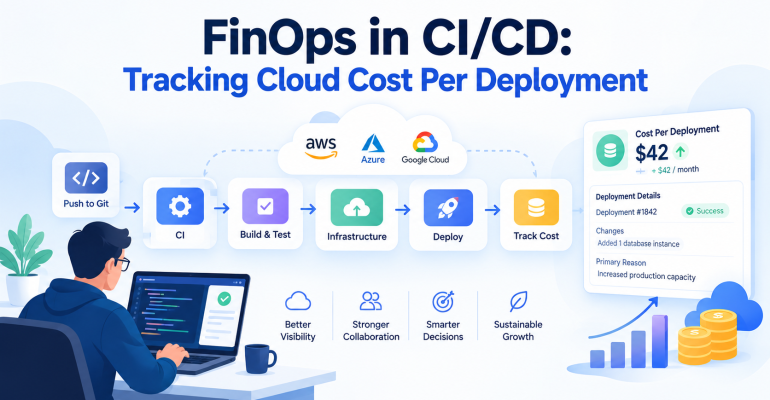
A developer makes a change → pushes code → CI runs tests → the application is built → infrastructure is updated → deployment goes to production.
We usually track things like:
- Deployment status
- Build time
- Test results
- Failed deployments
- Application performance
But what if we also tracked
Cost per deployment?
For example:
Deployment #1842 added a new database instance and increased the estimated monthly cloud cost by $42.
Suddenly, the deployment pipeline is giving us more than a “successful” or “failed” message.
It is giving us financial context.
Why Does Cost Per Deployment Matter?
Imagine an engineering team deploys 20 times a day.
Each deployment looks harmless.
But over time, developers might introduce larger instances, additional storage, more replicas, extra load balancers, or services that aren’t being used efficiently.
Nobody necessarily made a bad decision.
The problem is that small infrastructure decisions can accumulate into a big cloud bill.
Tracking cost alongside deployments makes those decisions visible.
Instead of discovering at the end of the month that cloud spending increased by 30%, the team can identify which changes contributed to that increase.
How Does It Work?
The basic idea is to connect your CI/CD pipeline with cloud cost information.
A simplified workflow could look like this:
Developer → Git Push → CI/CD Pipeline → Infrastructure Change → Cost Estimation → Deployment → Cost Tracking
For infrastructure-as-code tools such as Terraform, the pipeline can analyze infrastructure changes before they are applied.
For example:
Terraform Plan
↓
Infrastructure Changes
↓
Cost Estimation
↓
CI/CD Pipeline
↓
Approval
↓
Deployment
Now imagine a pull request that says:
“Add 3 EC2 instances”
Along with the usual infrastructure diff, the pipeline could report:
Estimated additional cost: $85/month
That information can change the conversation completely.
The engineer might realize that 3 instances aren’t actually necessary.
Or the team might decide that the additional cost is justified.
The important part is that the decision is informed.
FinOps Doesn’t Mean “Spend Less”
This is an important point.
FinOps isn’t simply about cutting cloud costs.
Sometimes spending more is the right decision.
For example, upgrading a server might cost an additional $100 per month but significantly improve application performance and reduce downtime.
That’s a good engineering decision.
The goal of FinOps is not:
“Always choose the cheapest option.”
The goal is:
“Understand the cost of the option you’re choosing.”
That is a much healthier approach.
Bringing Engineers and Finance Together
One of the biggest benefits of FinOps in CI/CD is that it brings engineering and financial accountability closer together.
Finance teams can understand where cloud money is being spent.
Engineering teams can understand the financial impact of technical decisions.
Management gets better visibility.
And everyone can work with the same information.
Instead of finance asking:
“Why did the AWS bill increase this month?”
The engineering team can already see:
“The increase came mainly from the new production cluster and increased database capacity.”
That’s a much better conversation.
What Should We Track?
A mature FinOps-enabled CI/CD setup could track several useful metrics:
- Cloud cost per deployment
- Cost change per pull request
- Cost by application
- Cost by environment
- Cost by team
- Cost by service
- Monthly cost trends
- Estimated vs actual infrastructure cost
- Idle or underutilized resources
You don’t necessarily need to implement everything on day one.
Even starting with estimated cost changes during infrastructure pull requests can provide significant value.
The Human Side of FinOps
Technology is rarely just about tools.
The biggest change with FinOps is often cultural.
Developers start asking:
“Do we really need this resource?”
DevOps engineers start asking:
“Can we design this infrastructure more efficiently?”
Managers start asking:
“Is this increase in cloud spending creating enough business value?”
These are healthy questions.
The objective isn’t to slow developers down or make every deployment require a finance meeting.
It’s about creating a culture where cost becomes another engineering metric, just like performance, reliability, and security.
The Future of CI/CD Is More Than Deployment
CI/CD pipelines have already evolved from simply building and deploying code.
Modern pipelines can include security scanning, testing, compliance checks, infrastructure validation, and observability.
FinOps is another important piece of that evolution.
Imagine a future deployment pipeline that tells you:
Deployment: #1842
✓ Tests Passed
✓ Security Scan Passed
✓ Infrastructure Validated
✓ Deployment Successful
Estimated Cost Impact:
+$42/month
Primary Reason:
Additional production database capacity
That’s powerful because it connects code, infrastructure, and money in one workflow.
Final Thoughts
Cloud computing gave engineering teams incredible freedom.
But with that freedom comes responsibility.
Every infrastructure decision has a financial impact, whether we see it immediately or not.
FinOps in CI/CD helps make that impact visible at the moment decisions are being made—not weeks later when the cloud bill arrives.
The real goal isn’t simply to reduce the cloud bill.
It’s to build a culture where engineers understand the relationship between what they deploy, how it performs, and what it costs.
Because in modern DevOps, a successful deployment isn’t just one that works.
It should also make sense technically, operationally, and financially.