
Beyond Drag-and-Drop: How AI Agents are Redefining Low-Code & No-Code
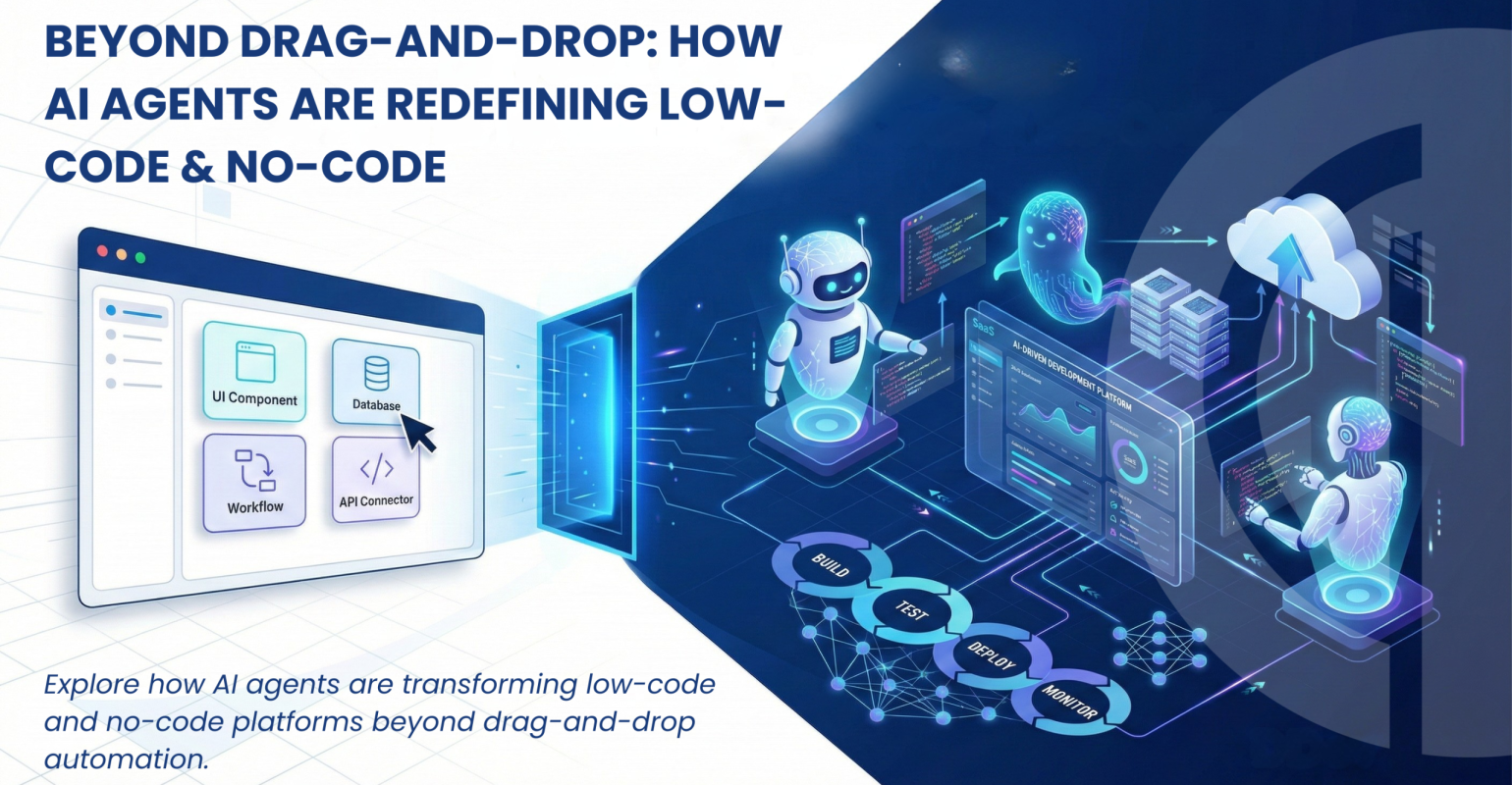
Beyond Drag-and-Drop: How AI Agents are Redefining Low-Code & No-Code
 hamna Siddiqui
 Explore how AI agents are transforming low-code and no-code platforms beyond drag-and-drop automation.
Table of Contents
- Introduction
- The Original Role of Low-Code / No-Code
- The AI Inflection Point: From Visual Abstraction to Intent-Driven Creation
- The Next Evolution: AI-Native Low-Code Platforms
- Natural Language as the Primary Interface
- Conversation Instead of Configuration
- Self-Improving Systems
- Open, Portable Code
- What This Means for the Industry
- Software Creation Becomes Truly Universal
- Pressure on Legacy LCNC Vendors
- Developers Shift Up the Stack
- New Governance Challenges
- An Explosion of Shadow Software
- Conclusion: From Visual Builders to Intent-Drive Software
Introduction
For many years, low-code and no-code platforms in the LCNC market came with a bold
promise: software for everyone. With LCNC, business users such as product managers,
analysts, or startup founders were finally given the ability to develop software without coding.
It was no surprise that such platforms revolutionized the way businesses treated innovation
in terms of speed. Syntax was replaced by visual builders, while frameworks were replaced
by drag-and-drop interfaces.
This approach worked until a new variable came into play.
AI-assisted development goes beyond LCNC enhancement. In fact, AI-assisted
development is redefining what “low code” can mean
The Original Role of Low-Code / No-Code
Ultimately, it was all front-end, concealing complexity beneath the surface of these platforms
in LCNC. That means developers build applications by dragging and dropping versus
actually fighting with code, whether it be in JavaScript or Python or in back-end coding.
Examples of such platforms include Bubble, Appian, OutSystems, and Microsoft Power
Platform.
- These were all extremely useful to determine:
- Fast prototyping and testing
- Automation and other tools owned by the company.
- Reduce dependence on overextended engineering personnel.
However, these advances came with certain compromises. The system lacked flexibility. It
led to scaling challenges for uses after the first ones. Furthermore, the system caused
vendor lock-in for painful evolution in the future. LCNC addressed speed but not the
freedom.
The AI Inflection Point: From Visual Abstraction to Intent-Driven Creation
Generative AI represents a whole different paradigm. The end results of programming could
now be generated from an understanding of the natural language inputs provided to code.
This means being able to write the software logic, wiring the APIs, creation of test code, and
even debugging code.
Subtle, yet deep-a very profound shift:
- LCNC eliminated the need for coding.
- AI does not need an instruction manual.
- Instead of controlling graphic elements, users can express intent:
- This will be a subscription web-based application powered by Stripe payment integration, with role-based authentication and analytics dashboards.
- An AI agent not only satirizes this, but an AI agent produces code here.
- The abstraction layer on which LCNC once relied is no longer the center of attention.
The Next Evolution: AI-Native Low-Code Platforms
This does not spell the demise of LOW CODE or NO CODE as a technology. It means
transformation.
The next generation of LCNC platforms simply won’t be with a focus on visual development
tools first but AI-first environments, in which the visuals serve to support and verify work
done by intelligent agents.
What this new framework now can be used for:
Natural Language as the Primary Interface:
Users describe outcomes, not workflows. The AI translates intent into architecture, logic, and
integration.
Conversation Instead of Configuration
Unless it is designing flowcharts, the user communicates in business language:
“Notify customer, update inventory, CRM sync – when an order is placed.”
Handling implementation and validation is done byAgent
Self-Improving Systems
AI not only develops code but also monitors its execution, points out where there are
inefficiencies, removes defects, and changes the system accordingly.
Open, Portable Code
Unlike the traditional LCNC black boxes, AI-native platforms will output readable,
standards-based code that can live beyond the platform itself.
Where, AI acts like the engine, and the LCNC interface becomes a guiding layer; more of a
collaborator than the builder.
What This Means for the Industry
The ripple effects are significant:
Software Creation Becomes Truly Universal
Today, anyone with the ability to describe intent—managers, designers, and operators—is
enabled to take a full part in the
Pressure on Legacy LCNC Vendors
However, if platforms are only visual, they may become outdated, just like Flash during the
HTML5 era. Now, adaptation is no longer a choice.
Developers Shift Up the Stack
Knowledge of syntax is less important. Architectural thinking, system governance, data
integrity, and management are more important. Application programmers become innovators
and managers of AI agents.
New Governance Challenges
“Who is going to be responsible for the security, compliance, and quality of the code if the
code is going to be written by AI systems?” In this respect, developing a new set of
frameworks to audit and trust
An Explosion of Shadow Software
The more frictionless creation becomes, the more internal applications will evolve.
Integration, lifecycle, and observability will become a core concern for information
technology.
Conclusion: From Visual Builders to Intent-Driven Software
“The original mission of low-code/no-code, which is to enable more people to build software,
remains relevant. However, the mechanism by which this mission is fulfilled is likely to shift.”
The future is not about more drag-and-drop functionality. The future is about AI systems
direct translation of the user’s intent into working software.
From components → to language
From workflows → to ideas
The winning platforms will integrate simple interfaces with intelligent AI agents that provide
systems that are anything but simple behind an ease-of-use experience. Lastly, the future of
no-code does not pertain to the eradication of code. It’s code that’s been written in an
intelligent way; by machines, with human oversight that thinks about outcomes, not code
Written By Reeshaiel Shah


