
Common API Security Mistakes Every Developer Should Avoid:
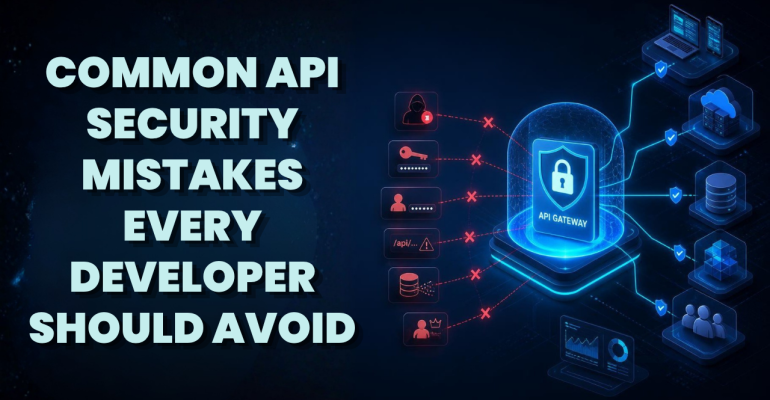
Common API Security Mistakes Every Developer Should Avoid:
 hamna Siddiqui
Discover why Platform Engineering is shaping the future of DevOps by improving developer productivity, automation, scalability, and delivery speed.
Table of Contents
- Introduction
- Weak Authentication and Authorization
- Exposing Sensitive Data
- Lack of Rate Limiting
- Trusting User Input
- Using Insecure HTTP Instead of HTTPS
- Outdated Dependencies
- Missing Logging and Monitoring
- Best Practices for Secure API
- Conclusion
Introduction
APIs (Application Programming Interfaces) have become the foundation of modern software. Whether you’re ordering food, making an online payment, logging in with Google, or checking the weather on your phone, APIs are working behind the scenes to connect different applications and exchange data.
As APIs become more powerful and widely used, they also become attractive targets for cybercriminals. A single vulnerable API can expose sensitive customer information, financial records, or even provide attackers with access to an entire system. Unfortunately, many of these security issues aren’t caused by advanced hacking techniques—they’re the result of simple mistakes made during development.
The good news is that most API vulnerabilities can be prevented with proper planning and secure coding practices. Let’s explore some of the most common API security mistakes and learn how to avoid them.
Weak Authentication and Authorization
One of the biggest mistakes developers make is assuming that authentication alone is enough. Authentication verifies who a user is, while authorization determines what that user is allowed to access.
Imagine an online banking application where a logged-in user changes an account ID in the URL and suddenly gains access to another customer’s information. This happens when authorization checks are missing.
To prevent this:
- Verify user permissions on every request.
- Use secure authentication methods such as OAuth 2.0 or JWT.
- Never rely solely on client-side validation.
Strong authentication combined with proper authorization forms the first line of defense for any API.
Lack of Rate Limiting
Without rate limiting, an attacker can send thousands of requests within seconds. This can lead to brute-force attacks, denial-of-service (DoS) attempts, or abuse of expensive API operations.
For example, a login endpoint without request limits allows attackers to repeatedly guess passwords until they succeed.
Implementing rate limiting helps protect APIs by restricting the number of requests users can make during a specific period.
Common approaches include:
- Limiting requests per IP address.
- Limiting requests per authenticated user.
- Temporarily blocking repeated failed login attempts.
Rate limiting protects both your infrastructure and your users.
Trusting User Input
Many security vulnerabilities begin with one simple mistake: trusting user input.
Attackers can submit malicious data to exploit SQL Injection, NoSQL Injection, Cross-Site Scripting (XSS), or command injection vulnerabilities.
Instead of trusting incoming data, APIs should always validate and sanitize every input before processing it.
Good practices include:
- Validate data types and formats.
- Use parameterized database queries.
- Reject unexpected values.
- Escape special characters where necessary.
Remember, every piece of data coming from the client should be considered untrusted until verified.
Using Insecure HTTP Instead of HTTPS
Data transmitted over plain HTTP can be intercepted by attackers on public networks. Login credentials, personal information, and session tokens become vulnerable to eavesdropping.
HTTPS encrypts communication between clients and servers, making it significantly harder for attackers to steal sensitive information.
Every production API should:
- Enforce HTTPS.
- Redirect HTTP traffic automatically.
- Use modern TLS versions.
- Keep SSL certificates updated.
Today, there is virtually no reason to expose production APIs over unsecured HTTP.
Poor Error Handling
Detailed error messages may seem helpful during development, but they can unintentionally reveal valuable information to attackers.
For example, an API returning database names, file paths, software versions, or stack traces gives attackers clues about the underlying system.
Instead:
- Return generic error messages to users.
- Log detailed errors only on the server.
- Avoid exposing internal implementation details.
A message like “Something went wrong. Please try again later.” is far safer than displaying a full exception stack trace.
Outdated Dependencies
Modern applications rely heavily on third-party libraries and frameworks. While these tools speed up development, they can also introduce security vulnerabilities if left outdated.
Many well-known cyberattacks have exploited publicly known vulnerabilities in outdated software that developers simply forgot to update.
Developers should:
- Regularly update dependencies.
- Remove unused packages.
- Monitor security advisories.
- Perform dependency vulnerability scans.
Keeping software updated is one of the easiest ways to improve API security.
Missing Logging and Monitoring
Even well-protected APIs can experience security incidents. Without proper logging, developers may never know an attack occurred.
Effective monitoring helps identify:
- Unusual login attempts.
- Large numbers of failed requests.
- Suspicious API usage.
- Unexpected spikes in traffic.
Logs should be securely stored and regularly reviewed. Combining logging with automated monitoring tools allows organizations to detect threats early and respond before significant damage occurs.s are becoming more capable of doing tasks that used to need people.
Best Practices for Secure APIs1
Developing secure APIs is not about adding one security feature—it requires multiple layers of protection working together.
Some recommended best practices include:
- Always authenticate and authorize users.
- Use HTTPS for every API request.
- Validate all user inputs.
- Apply rate limiting.
- Encrypt sensitive data.
- Keep libraries and frameworks updated.
- Monitor API activity continuously.
- Follow the principle of least privilege.
- Conduct regular security testing and code reviews.
Building security into the development process from the beginning is far easier than fixing vulnerabilities after deployment.
Conclusion
APIs have become an essential part of nearly every modern application, making their security more important than ever. Many of the most dangerous API vulnerabilities don’t result from highly sophisticated attacks—they arise from everyday development mistakes such as weak authentication, excessive data exposure, poor input validation, and outdated software.
The encouraging news is that these issues are largely preventable. By following secure development practices, validating every request, limiting unnecessary access, and regularly maintaining your software, you can significantly reduce the risk of security breaches.
Security should never be treated as an afterthought. A secure API not only protects your application but also builds trust with users, safeguards sensitive information, and ensures long-term reliability. Investing time in API security today can prevent costly incidents and protect both your business and your customers in the future.
.
Stay tuned to blogs.ddevops.com for more deep dives into Infrastructure as Code, CI/CD,
automation, and Silo-Free Engineering
Reference Link:
Reference Blog for you:
How to Install and Configure Zabbix 6.0: Complete Guide
The Evolution of DevOps: Development and Operations
Introduction to CI/CD Pipelines
Written by Reeshaiel Shah